
IB Physics HL Book 2025; Papers 1 & 2 Practice 5 Sections65 Lessons54 Weeks
Simple Harmonic Motion
Lesson C.1 Simple Harmonic Motion
Lesson Notes, Worked Examples and Exam Practice
These notes explain simple harmonic motion using the notation shown in the IB formula booklet. Amplitude is represented by  , and displacement from equilibrium by
 . Read each explanation, attempt the examples, then expand the worked answers to check your reasoning.
Lesson Map
C.1.1: Oscillations and the defining condition for SHM.
C.1.2: Mass–spring systems and simple pendulums.
C.1.3: Position, velocity, acceleration and phase — additional HL.
C.1.4: Energy in SHM — additional HL.
Use  unless stated otherwise. Give numerical answers to 2–3 significant figures. Keep extra digits in working and use radians when evaluating phase angles.
Learning Objectives
- Define equilibrium position, displacement , amplitude , period
 , frequency
 and angular frequency
 .
- Identify SHM using
 and explain the restoring direction.
- Calculate spring and pendulum periods, stating the assumptions.
- Interpret displacement, velocity and acceleration graphs.
- Use the phase constant to describe different initial conditions.
- Calculate total, kinetic and potential energies for an ideal oscillator.
IB Formula Reference — C.1
Symbols: is signed displacement from equilibrium; is amplitude;  is pendulum length;
 is total oscillation energy;
 is oscillation potential energy.
Standard Level and Higher Level


Additional Higher Level


The pendulum equation assumes small angular oscillations. The sign of velocity depends on the direction of motion. In this notation, denotes amplitude. The displacement at time zero is  , which need not equal the amplitude.
C.1.1 — Oscillations and Simple Harmonic Motion (SL and HL)
Equilibrium Position and Oscillation
An oscillation is repeated motion about an equilibrium position. Imagine a swing: after pushing stops and the rider no longer pumps it, damping makes the oscillations smaller until the swing comes to rest beneath the pivot.

The equilibrium position is a position where the object can remain at rest because the net force is zero:  . A stable equilibrium has a restoring tendency when the object is displaced slightly.
Not every oscillation is SHM. To qualify as SHM, the restoring acceleration must obey a specific proportional relationship with displacement.
Displacement and Amplitude
Definitions Using IB Notation
Displacement, : the signed position relative to equilibrium. It can be positive, negative or zero.
Amplitude, : the maximum magnitude of displacement. It is non-negative.
 . The turning points are
 and
 . Their separation is
 , called the peak-to-peak displacement.
Displacement changes throughout a cycle. Amplitude remains constant in ideal undamped SHM, but decreases when damping removes energy.
Period, Frequency and Angular Frequency
| Quantity | Meaning | Unit |
|---|---|---|
| Period |
Time for one complete cycle. | s |
| Frequency |
Number of complete cycles per second. | Hz |
| Angular frequency |
Rate of change of phase angle. | rad s⁻¹ |
Useful rearrangements are  and
 . One complete cycle corresponds to a phase increase of
 radians. Angular frequency describes progress through the cycle; it is not a constant linear speed of the particle.
Common Misconception
Frequency counts cycles per second; angular frequency counts radians of phase per second. Always include the factor when converting between them.
The Defining Condition for SHM
SHM occurs when acceleration is proportional to displacement from equilibrium and directed towards equilibrium. The proportionality coefficient is constant for a given ideal oscillator.
If displacement is positive, acceleration is negative. If displacement is negative, acceleration is positive. At equilibrium,  and the SHM acceleration is zero. At either turning point, acceleration magnitude is maximum:


Reading an Acceleration–Displacement Graph
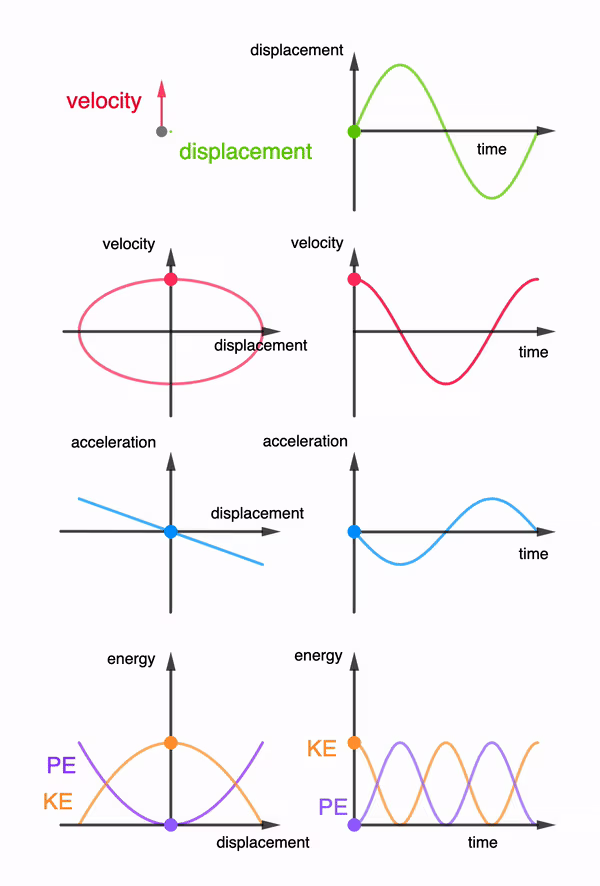
A graph of acceleration against displacement for ideal SHM is a straight line through the origin, with gradient  . Thus
 .
A force pointing towards equilibrium is necessary but is not sufficient by itself: proportionality to displacement must also be established. A single acceleration–displacement measurement cannot prove SHM.
Worked Example 1 — Angular Frequency Ratio
Oscillator A has period  . Oscillator B has frequency
 . Determine
 .
Show worked answer
Step 1:  .
Step 2:  and
 .
Step 3:  .
Answer:  .
C.1.2 — Mass–Spring Systems and Simple Pendulums (SL and HL)
Mass–Spring System

For an ideal horizontal mass–spring system, the spring is unstretched at equilibrium. Assume a light spring obeying Hooke’s law, a constant oscillating mass and negligible friction.

Comparing with gives  . Therefore:

What the Spring Equation Tells Us
Increasing mass increases inertia and lengthens the period:  . Increasing spring stiffness shortens the period:
 .
The ideal period does not depend on amplitude , provided the spring remains within its Hooke’s-law range.
A Vertical Spring: Measure from Equilibrium
Gravity stretches a vertical spring to a new equilibrium, where  . If downward displacement from this equilibrium is , then
 .
The ideal period is still  . Use displacement from equilibrium in the SHM equation. Here
 denotes the equilibrium spring extension; denotes the oscillation amplitude.
Simple Pendulum — Period Derivation Without Calculus
Consider a bob of mass  suspended from a light, inextensible string of length . Displace it by a small angle
 from the vertical. Let be its signed arc displacement from equilibrium.

Step 1 — Relate angle and arc displacement: because the angle is in radians,  , so
 .
Step 2 — Identify the restoring force: the tangential component of weight acts towards equilibrium:  . Tension acts radially and has no tangential component.
Step 3 — Apply the small-angle approximation:  . Therefore:

Step 4 — Use Newton’s second law tangentially:  . Here
 is the tangential acceleration along the arc. Cancelling mass gives:

Step 5 — Compare with SHM: , so  . Using
 :

Assumptions and an Important Distinction
The pendulum equation applies within the small-angle approximation. Assume negligible damping, a light inextensible string, a point-like bob and constant gravitational field strength. The period is approximately independent of bob mass and amplitude.
The acceleration used in the derivation is tangential acceleration. The moving bob also has radial centripetal acceleration, so its total acceleration need not vanish at the bottom.
At larger angular amplitudes, the period is longer than the small-angle prediction.
Why No Calculus Is Needed Here
SHM can be represented by the projection of uniform circular motion. An object moving around a circle of radius at angular speed has centripetal acceleration magnitude  . Projecting position and acceleration onto a diameter gives .
This geometric relationship, together with Newton’s second law and the small-angle approximation, supplies the pendulum derivation above.
Worked Example 2 — Pendulum Length
A small-angle simple pendulum completes four full oscillations in  . Determine its length. Use .
Show worked answer
Step 1:  , so
 .
Step 2: rearrange  to obtain
 .

Answer:  .
Worked Example 3 — Spring Constant
A mass of  attached to an ideal spring undergoes SHM with frequency
 . Calculate the spring constant.
Show worked answer
Step 1: convert mass:  .
Step 2: and , so  .

Answer:  to two significant figures.
C.1.3 — Position, Velocity, Acceleration and Phase (Additional HL)

The General IB Equations
For an ideal oscillator, the IB displacement equation is:
The corresponding velocity equation is:
The acceleration remains:

Here  is the initial phase constant, while
 is the phase at time
 . The phase constant depends on the chosen starting conditions.
Choosing the Initial Phase
Crossing equilibrium positively: choose  , giving
 .
Crossing equilibrium negatively: choose  .
Released from rest at : choose  . Then
 .
The cosine form is equivalent to the IB sine form with a suitable phase constant.
Reading the Graphs
The gradient of a displacement–time graph is velocity,  . The gradient of a velocity–time graph is acceleration,
 .
Speed is greatest at equilibrium crossings and zero at turning points. Acceleration magnitude is greatest at turning points and the SHM acceleration is zero at equilibrium.
Velocity leads displacement by  radians. Acceleration and displacement are in antiphase: their phase difference is
 radians.
| Time for |
Displacement | Velocity | Acceleration |
|---|---|---|---|
 |
|
 |
|
 |
 |
|
 |
 |
|
 |
|
 |
 |
|
 |
|
|
|
|
Velocity at a Specified Displacement
Eliminating phase between the displacement and velocity equations gives  . The IB formula is:
Choose the positive sign for motion in the positive direction and the negative sign for motion in the negative direction. At most positions, the oscillator passes once in each direction during a cycle.
Taking the magnitude gives speed:

C.1.4 — Energy in SHM (Additional HL)

In an ideal oscillator, energy transfers continuously between kinetic and potential energy while total mechanical energy remains constant. A pendulum exchanges kinetic and gravitational potential energy; a horizontal spring oscillator exchanges kinetic and elastic potential energy.
Choose zero oscillation potential energy at the equilibrium minimum. At a turning point, speed is zero and all oscillation energy is potential. At equilibrium, this potential energy is zero and all oscillation energy is kinetic.
Total Energy — IB Formula

For a spring,  , so the equivalent expression is:

Potential Energy — IB Formula

For a horizontal spring, this becomes  . It is zero at equilibrium and maximum at
 .
Kinetic Energy


For a spring, an equivalent expression is  .
How the Energies Change with Time
Substituting  gives:


Energy Patterns and Amplitude
Kinetic energy has two maxima per displacement cycle because the oscillator crosses equilibrium twice. Both directions give the same kinetic energy because velocity is squared.
Kinetic and potential energies each repeat after . Their sum remains constant because  .
Total energy is proportional to  . Doubling amplitude quadruples energy while leaving the ideal spring period unchanged.
Potential Energy in a Vertical Spring
For displacement measured from vertical equilibrium, is the combined spring-plus-gravitational potential energy above its equilibrium minimum. Actual spring elastic energy is  , where is the equilibrium extension.
Damping and Real Oscillators
Friction and resistance transfer mechanical energy to the surroundings. The amplitude decreases, so the motion is not exact undamped SHM. With weak damping, the motion can remain approximately sinusoidal and its period close to the ideal value.
IB-Style Exam Practice
Show working, include units and state assumptions. Attempt each question before expanding its answer.
Question 1 — Period, Frequency and Angular Frequency
A particle oscillates with period  .
(a) Calculate the frequency.
(b) Calculate the angular frequency.
(c) State the units of each.
Show worked answer
(a)  .
(b)  .
(c) Frequency is measured in hertz; angular frequency in radians per second.
Question 2 — Identifying SHM from an Acceleration Graph
An acceleration–displacement graph is a straight line through the origin with gradient  .
(a) Explain why this indicates SHM.
(b) Determine the angular frequency.
(c) Calculate the period.
Show worked answer
(a) A straight line through the origin establishes proportionality between acceleration and displacement. Its negative gradient establishes a restoring direction, matching .
(b)  , so
 .
(c)  .
Question 3 — Mass–Spring Period and Changing Mass
A mass on an ideal spring has period  . The mass is changed to
 while the spring is unchanged.
(a) Determine the new period.
(b) Explain physically why the period increases.
Show worked answer
(a) , so  .
(b) Greater mass gives greater inertia. For a given displacement, the same spring force produces a smaller acceleration, so the oscillation takes longer.
Question 4 — Simple Pendulum and Ratios
Pendulum A has twice the bob mass and half the length of pendulum B. Both oscillate at small amplitude in the same gravitational field.
Determine  .
Show worked answer
The small-angle period is independent of bob mass and proportional to  . Thus:

Answer:  .
Question 5 — Displacement and Velocity at a Given Time
An oscillator has amplitude  and frequency
 . It crosses equilibrium at
 moving positively, so .
(a) Determine the angular frequency.
(b) Calculate displacement at  .
(c) Calculate velocity at that time.
Show worked answer
(a)  .
(b) Use the unrounded angular frequency:  . Using :

(c) Using  :

Here  and
 , so the particle is exactly at a turning point in the ideal model.
Question 6 — Energy at a Displacement
An ideal horizontal mass–spring oscillator has  and amplitude
 . Measure displacement from the unstretched equilibrium position.
(a) Determine total energy.
(b) Determine potential energy at  .
(c) Determine kinetic energy there.
Show worked answer
For a spring, , so the IB energy equations can be written using the given spring constant.
(a) 
(b) 
(c)  .
Key Ideas to Take Away
- Use for amplitude and for displacement.
- SHM is defined by : acceleration is restoring and proportional to displacement.
 links period, frequency and angular frequency.
- Ideal spring: . Small-angle pendulum: .
- Use and , with a phase constant matching the initial conditions.
- Use
 and choose the sign from the direction of motion.
- Use
 ,
 and
 .
- Each kinetic and potential energy pattern repeats twice per displacement cycle.
Studying with Gratitude and Integrity
Memory verse — Psalm 111:2 (KJV):
“The works of the LORD are great, sought out of all them that have pleasure therein.”
Creation: Studying oscillations invites us to investigate the order of the created world. Hebrews 1:2–3 teaches that God made the universe through His Son, who sustains all things by His powerful word. Our learning can express gratitude to Jesus Christ, the Creator and Sustainer.
The Fall: Pride can make us unwilling to admit mistakes, while fear can tempt us to hide them. First John 1:5–9 calls us to walk in God’s light, acknowledge our sin and receive His forgiveness. In science, integrity includes reporting results honestly and recognising the limits of evidence.
Redemption: Jesus died for our sins and rose again so that we could be reconciled to God. Our worth is not measured by an examination grade. Turn to Him in repentance and faith, receiving Him as your personal God, Saviour and Lord.
Restoration: Revelation 21:3–5 gives believers hope of complete restoration in God’s presence. Grow in faith through reading and studying the Bible, spending time in prayer and connecting with other believers in a local church. Use your learning to encourage and serve others.
Reflection: How can you approach a difficult lesson with honesty, perseverance and gratitude?
Prayer: Lord Jesus, thank You for Your creation and saving love. Help me learn with patience, work honestly and use my understanding to serve others. Guide me through Your Word, prayer and fellowship. Amen.
2 Comments
I have a question about the formula of displacement and the velocity, because it’s different to the data booklet that we have now. In this website it doesn’t show the phase constant, but our booklet is showing the phase constant, for example, x=amplitude * sin(angular frequency * time period + phase constant. I wonder why this website didn’t include the phase constant.
Simple Harmonic Motion: Displacement and Phase
Both formulas are correct, but the expression containing a phase constant is more general:
In this equation:
is measured from the equilibrium position.
is the maximum displacement from equilibrium.
is measured in radians per second.
is measured in seconds.
specifies where the object is in its oscillation when time is zero.
1. Without a Phase Constant
At the initial instant:
The object starts at equilibrium, moving in the positive direction. This is the special case in which the initial phase is zero.
2. With a Phase Constant
The initial displacement is:
The phase constant allows us to describe any starting point in the oscillation. It determines both the initial displacement and the initial direction of motion. The velocity is:
Therefore, the initial velocity is:
Example: Starting at Maximum Positive Displacement
If the object starts at maximum positive displacement and is released from rest, choose:
Then:
This gives the required initial conditions:
What Does the Phase Constant Change?
The phase constant changes the starting point of the oscillation, shifting the displacement–time graph horizontally. It does not change the amplitude, frequency or period.
IB Physics Exam Tip
Use the sine expression without a phase constant when the object starts at equilibrium and moves in the positive direction. For other starting conditions, include an appropriate phase constant or use a suitable cosine expression.
Remember: the amplitude is the maximum displacement from equilibrium; it is not necessarily the initial displacement.