

Simple Harmonic Motion 1
C.1.1 SIMPLE HARMONIC MOTION
IB Physics Study Guide and Workbook
Simple harmonic motion is one of the most important models of oscillatory motion in physics.
It is used to describe systems such as masses attached to springs, pendulums undergoing small
oscillations, vibrating objects and many wave-producing systems.
The central idea is that when an object is displaced from its equilibrium position, a restoring
force acts to bring it back toward equilibrium. For the motion to be simple harmonic,
the resulting acceleration must also be directly proportional to the displacement.
Learning Objectives
By the end of this section, you should be able to:
- describe oscillatory motion and identify examples of simple harmonic motion;
- define equilibrium position, displacement, amplitude, time period, frequency and angular frequency;
- distinguish between displacement and amplitude;
- calculate period, frequency and angular frequency;
- state and apply the defining condition for simple harmonic motion;
- explain the significance of the negative sign in the SHM equation;
- interpret an acceleration–displacement graph;
- determine angular frequency and period from an acceleration–displacement graph;
- calculate maximum acceleration;
- explain SHM using appropriate IB Physics terminology.
1. Oscillations and Equilibrium
An oscillation is repeated motion backwards and forwards about an equilibrium position.
Examples include:
- a child moving backwards and forwards on a swing;
- a mass attached to a spring;
- a pendulum;
- the prongs of a vibrating tuning fork;
- a guitar string after it has been plucked;
- atoms vibrating about fixed positions in a solid.
Not every oscillation is simple harmonic motion. Simple harmonic motion is a particular type of
oscillation that satisfies a specific relationship between acceleration and displacement.
Equilibrium Position
Imagine pushing a child on a swing. If you stop pushing, the swing continues to oscillate.
Because of friction and air resistance, the oscillations gradually become smaller until the
swing eventually comes to rest directly underneath the pivot.
This resting position is called the equilibrium position.
Definition: The equilibrium position is the position at which the resultant force
on the object is zero.
where
Fnet = resultant force on the oscillator (N)
From Newton’s second law:
where
m = mass of the oscillator (kg)
a = acceleration (m s−2)
Therefore, at equilibrium:
Important Idea
Zero acceleration does not mean zero velocity.
In ideal simple harmonic motion, the oscillator passes through the equilibrium position at its
maximum speed.
Therefore, at equilibrium:
where
x = displacement from equilibrium (m)
v = instantaneous velocity (m s−1)
vmax = maximum speed (m s−1)
Restoring Force
When an oscillator is displaced from equilibrium, a force acts to move it back toward equilibrium.
This is called a restoring force.
For example, if a spring is stretched to the right, the spring pulls the attached object toward
the left. If the spring is compressed to the left, it pushes the object toward the right.
In both cases, the restoring force is directed toward equilibrium.
For SHM to occur, displacement from equilibrium must produce a restoring acceleration directed
back toward equilibrium.
Diagram Guidance — Swing and Equilibrium Position
The swing diagram can be retained here. Label:
- A — one extreme position;
- B — equilibrium position;
- C — opposite extreme position;
- restoring force directed toward B;
- maximum displacement on either side of B.
The equilibrium position should be shown at the lowest point of the swing.
Check Your Understanding 1
- What is meant by equilibrium position?
- What is the resultant force at equilibrium?
- Is the velocity necessarily zero at equilibrium?
- In which direction does a restoring force act?
2. Displacement and Amplitude
Two terms that must be distinguished carefully are displacement and
amplitude.
Displacement
The displacement, x, is the position of an oscillator relative to its
equilibrium position at a particular instant.
Displacement has direction and may therefore be positive, negative or zero.
For example:
could mean that the oscillator is 3.0 cm to the right of equilibrium.
Similarly:
could mean that the oscillator is 3.0 cm to the left of equilibrium.
At equilibrium:
Amplitude
The amplitude, A, is the maximum magnitude of the displacement from equilibrium.
where
x = instantaneous displacement from equilibrium (m)
A = amplitude of oscillation (m)
Amplitude is always a positive quantity.
Example 1 — Identifying Amplitude
An oscillator moves between:
and
The amplitude is:
The distance between the two extreme positions is 10.0 cm, but this is
not the amplitude.
Answer: A = 5.0 cm
Displacement versus Amplitude
The displacement x:
- changes throughout the motion;
- may be positive, negative or zero;
- tells us where the oscillator is at a particular instant.
The amplitude A:
- is the maximum displacement;
- is always positive;
- remains constant in ideal undamped SHM;
- decreases if energy is removed from the system by damping.
A larger amplitude also means that the oscillator has more total mechanical energy.
Students sometimes calculate the distance from one extreme position to the other and call this
the amplitude. If an oscillator moves from −A to +A, the distance between the extreme positions
is 2A. The amplitude is only A.
Practice 2
An oscillator moves between −8.0 cm and +8.0 cm.
- State its amplitude.
- Determine the total distance between its two extreme positions.
- State its displacement when it passes through equilibrium.
3. Time Period and Frequency
Oscillations repeat after a fixed interval of time. Two important quantities used to describe
this repetition are period and frequency.
Time Period
The time period, T, is the time taken for one complete oscillation.
Unit: s
A complete oscillation means returning to the same position and moving in the same direction.
For example:
represents one complete oscillation.
Frequency
The frequency, f, is the number of complete oscillations made per second.
Unit: Hz
Period and frequency are related by:
1
T
where
f = frequency (Hz)
T = time period (s)
The relationship may also be written as:
1
f
Worked Example 2 — Finding Frequency
An oscillator has a period of 0.80 s. Calculate its frequency.
Step 1: Write the equation.
Step 2: Substitute.
Step 3: Calculate.
Answer: f = 1.25 Hz
Worked Example 3 — Measuring Several Oscillations
A pendulum completes 20 oscillations in 16.0 s. Calculate its period and frequency.
Step 1: Calculate the period.
Step 2: Calculate the frequency.
Answers:
T = 0.800 s
f = 1.25 Hz
Why Measure Several Oscillations?
In practical experiments, measuring the time for only one oscillation can produce a large
percentage uncertainty because human reaction time becomes significant.
It is usually better to time 10, 20 or more oscillations and then calculate the period.
Use:
This reduces the effect of reaction-time uncertainty.
Practice 3
- An oscillator completes 12 oscillations in 9.6 s. Calculate its period.
- Calculate its frequency.
- A second oscillator has frequency 4.0 Hz. Calculate its period.
- Which oscillator completes more oscillations in one minute?
4. Angular Frequency
Frequency f measures the number of complete cycles per second.
In SHM, it is also useful to describe the progress through an oscillation using an angle measured
in radians.
One complete oscillation corresponds to:
The angular frequency, ω, tells us how rapidly the phase angle changes.
where
ω = angular frequency (rad s−1)
f = frequency (Hz)
Since:
we can also write:
where
T = time period (s)
Frequency and Angular Frequency
Frequency and angular frequency are related but are not the same quantity.
Frequency, f:
- counts cycles per second;
- is measured in Hz.
Angular frequency, ω:
- describes the rate of change of phase;
- is measured in rad s−1.
Their relationship is:
Worked Example 4 — Angular Frequency
An oscillator has frequency:
Calculate its angular frequency.
Step 1: Write the equation.
Step 2: Substitute.
Step 3: Calculate.
Answer: ω = 18.8 rad s−1
Worked Example 5 — Angular Frequency from Period
An oscillator has a period of:
Calculate its angular frequency.
Answer: ω = 25.1 rad s−1
Practice 4
- Calculate the angular frequency of an oscillator with f = 2.0 Hz.
- Calculate the angular frequency of an oscillator with T = 1.5 s.
- An oscillator has angular frequency 12.0 rad s−1. Determine its frequency.
- Determine its period.
5. Defining Condition for Simple Harmonic Motion
The defining equation of simple harmonic motion is:
where
a = acceleration (m s−2)
ω = angular frequency (rad s−1)
x = displacement from equilibrium (m)
This equation contains the two essential conditions for SHM.
Condition 1: Acceleration Is Proportional to Displacement
The magnitude of acceleration increases in direct proportion to the magnitude of displacement.
If the displacement doubles, the magnitude of acceleration doubles. If the displacement triples,
the magnitude of acceleration triples.
Condition 2: Acceleration Is Directed Toward Equilibrium
The acceleration always acts opposite to the displacement.
This is shown by the negative sign in:
Why the Negative Sign Matters
Suppose the positive x-direction is to the right.
If:
the object is on the right-hand side of equilibrium.
Then:
so the acceleration points to the left, toward equilibrium.
If:
the object is on the left-hand side of equilibrium.
Then:
so the acceleration points to the right, again toward equilibrium.
The acceleration is therefore always a restoring acceleration.
6. Acceleration at Different Positions
The SHM equation allows us to predict the acceleration anywhere in the motion:
At Equilibrium
Therefore:
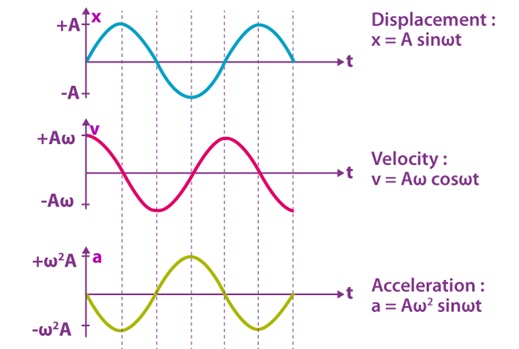
The speed is maximum at this position.
At Maximum Positive Displacement
Therefore:
The acceleration has maximum magnitude and points toward equilibrium.
At Maximum Negative Displacement
Therefore:
Again, the acceleration has maximum magnitude and points toward equilibrium.
7. Maximum Acceleration
The magnitude of acceleration is:
The maximum value of |x| is the amplitude A. Therefore:
where
amax = maximum acceleration magnitude (m s−2)
ω = angular frequency (rad s−1)
A = amplitude (m)
Worked Example 6 — Maximum Acceleration
A particle performs SHM with amplitude A = 0.040 m and frequency f = 5.0 Hz.
Calculate its maximum acceleration.
Step 1: Calculate angular frequency.
Step 2: Calculate maximum acceleration.
Answer: amax = 39.4 m s−2
Worked Example 7 — Acceleration at a Particular Displacement
An oscillator has angular frequency ω = 8.0 rad s−1.
At one instant its displacement is x = +0.030 m.
Calculate its acceleration.
Step 1: Write the SHM equation.
Step 2: Substitute.
Step 3: Calculate.
Answer: a = −1.92 m s−2
The negative sign shows that the acceleration acts in the negative direction.
Because the displacement is positive, the acceleration points toward equilibrium.
Practice 5
- An oscillator has ω = 4.0 rad s−1 and x = +0.050 m. Calculate its acceleration.
- Repeat the calculation for x = −0.050 m.
- Explain the physical meaning of the change in sign.
- An oscillator has amplitude 0.060 m and angular frequency 7.0 rad s−1. Calculate its maximum acceleration.
8. Acceleration–Displacement Graph
For SHM:
A graph of acceleration, a, against displacement, x, is therefore a straight line through the
origin with a negative gradient.
Therefore:
and:
Once ω is known, the period can be calculated from:
Why Does the Graph Demonstrate SHM?
A straight line through the origin shows that acceleration is proportional to displacement.
A negative gradient shows that acceleration and displacement have opposite directions.
This is the defining condition for simple harmonic motion.
Worked Example 8 — Acceleration–Displacement Graph
The acceleration–displacement graph of an oscillator is a straight line through the origin with
gradient −36 s−2.
Determine:
(a) the angular frequency;
(b) the period.
Step 1: Use the gradient relationship.
Step 2: Calculate the period.
Answers:
ω = 6.0 rad s−1
T = 1.05 s
If asked to show that the motion is simple harmonic, a strong answer is:
“The acceleration is directly proportional to the displacement from equilibrium and is directed
opposite to the displacement, toward equilibrium. Therefore, the motion is simple harmonic.”
Avoid writing only: “The object moves backwards and forwards.” That describes oscillatory motion
but does not establish that the motion is simple harmonic.
9. Worked Example — Angular Frequency Ratio
Oscillator A has period TA = 2.5 s.
Oscillator B has frequency fB = 0.20 Hz.
Determine the ratio ωA : ωB.
Step 1: Find the frequency of oscillator A.
Step 2: Find each angular frequency.
Step 3: Form the ratio.
Answer: ωA : ωB = 2 : 1
10. Common Misconceptions and Mistakes
1. “Every oscillation is SHM.”
Incorrect. For SHM, a ∝ −x must be satisfied.
2. “Velocity is zero at equilibrium.”
Incorrect. At equilibrium, x = 0 and a = 0, but the speed is maximum.
3. “Acceleration is maximum at equilibrium.”
Incorrect. At equilibrium, a = 0. The magnitude of acceleration is maximum at the extreme positions.
4. “Amplitude is the distance from one extreme position to the other.”
Incorrect. The distance between the extreme positions is 2A. The amplitude is A.
5. Confusing f and ω.
Frequency f is measured in Hz. Angular frequency ω is measured in rad s−1.
6. Ignoring the negative sign.
In a = −ω2x, the negative sign shows that acceleration acts in the direction opposite to displacement.
7. Saying only “there is a restoring force.”
For IB explanations, state that the acceleration is directly proportional to displacement from equilibrium and directed toward equilibrium.
11. IB Exam Tips
Tip 1 — Learn the Definition Precisely
“In simple harmonic motion, acceleration is directly proportional to displacement from equilibrium
and is directed toward equilibrium.”
Tip 2 — Use Physics Terminology
Instead of “It is pulled back,” write:
“A restoring force acts toward the equilibrium position, producing an acceleration opposite to the displacement.”
Tip 3 — Interpret the Sign of Acceleration Correctly
Negative acceleration does not necessarily mean the object is slowing down. The sign indicates
the direction of acceleration.
Tip 4 — Read Graph Axes Carefully
For an acceleration–displacement graph:
For a displacement–time graph, the gradient represents velocity. Do not apply the −ω2
gradient relationship to a displacement–time graph.
Tip 5 — Show the Physics Equation First
Write the relevant equation before substituting numerical values. This makes your reasoning clear
and may earn method marks even if a later arithmetic error occurs.
12. Practice Questions
A. Basic Understanding
- Define equilibrium position, displacement, amplitude, time period, frequency and angular frequency.
- State the defining condition for SHM.
- Explain what the negative sign represents in a = −ω2x.
- State the acceleration at equilibrium.
- State where the acceleration has its maximum magnitude.
B. Calculation Practice
Question 1
An oscillator has T = 0.50 s.
(a) Calculate its frequency.
(b) Calculate its angular frequency.
Question 2
An oscillator completes 24 oscillations in 18.0 s.
(a) Determine the period.
(b) Determine the frequency.
(c) Determine the angular frequency.
Question 3
An oscillator has ω = 10.0 rad s−1 and, at one instant,
x = +0.025 m. Calculate its acceleration and state its direction.
Question 4
An oscillator has A = 0.080 m and ω = 6.0 rad s−1.
Determine the maximum acceleration.
13. IB-Style Application Questions
Question 5 — Graph Interpretation
An acceleration–displacement graph is a straight line through the origin with gradient
−81 s−2.
(a) Explain why the motion is SHM.
(b) Determine the angular frequency.
(c) Determine the period.
(d) The amplitude is 0.040 m. Calculate the maximum acceleration.
Question 6 — Comparing Oscillators
Oscillator P has period TP = 0.40 s.
Oscillator Q has period TQ = 1.20 s.
(a) Determine fP : fQ.
(b) Determine ωP : ωQ.
(c) Explain why the two ratios are equal.
Question 7 — Reasoning
At a particular instant, an oscillator performing SHM has x > 0 and v < 0.
(a) State the direction of its acceleration.
(b) Is the oscillator moving toward or away from equilibrium?
(c) Is its speed increasing or decreasing? Explain.
14. HL Challenge
An oscillator performs SHM with angular frequency:
At one instant, its acceleration is:
(a) Determine the displacement.
Rearranging:
Substituting:
Answer: x = +0.0300 m
(b) Explain the signs.
The displacement is positive, meaning that the oscillator is on the positive side of equilibrium.
The acceleration is negative, so it points in the negative direction. Therefore, the acceleration
is directed toward equilibrium, as required for simple harmonic motion.
15. Key Ideas to Remember
The defining condition for simple harmonic motion is:
Period and frequency are related by:
Angular frequency is given by:
or:
Maximum acceleration is:
At equilibrium:
The speed is maximum at equilibrium.
At the extreme positions:
the velocity is zero and the magnitude of acceleration is maximum.
For an acceleration–displacement graph:
A straight line through the origin with negative gradient is therefore a key signature of simple harmonic motion.

You may also like
C.1 SHM HL
