
C.1 SHM HL
C.1 HIGHER LEVEL — PHASE, VELOCITY AND ENERGY IN SIMPLE HARMONIC MOTION
IB Physics HL Study Guide and Workbook
At Higher Level, simple harmonic motion is described quantitatively using
phase angle, sinusoidal equations for displacement and velocity,
and equations for kinetic, potential and total energy.
These relationships allow us to determine not only where an oscillator is,
but also how fast it is moving, in which direction it is moving, and how its
energy is distributed at any point during the oscillation.
Learning Objectives
By the end of this section, you should be able to:
- describe SHM using phase angle;
- use radians in phase calculations;
- use the displacement equation for SHM;
- use the velocity equation for SHM;
- determine speed from displacement;
- calculate the total energy of an oscillator;
- calculate potential and kinetic energy at any displacement;
- describe quantitatively how energy changes during an oscillation;
- explain the phase relationships between displacement, velocity and acceleration.
1. Phase in Simple Harmonic Motion
An oscillator repeatedly passes through the same sequence of positions and velocities.
To describe exactly where the oscillator is within its cycle, we use its
phase.
Definition
The phase of an oscillator describes its position within one complete
cycle of oscillation.
The phase angle is measured in radians.
One complete oscillation corresponds to:
Therefore:
- one quarter of a cycle corresponds to π/2 rad;
- half a cycle corresponds to π rad;
- three quarters of a cycle corresponds to 3π/2 rad;
- one complete cycle corresponds to 2π rad.
Phase Angle
The phase angle at time t is:
where
ω = angular frequency (rad s−1)
t = time (s)
φ = phase constant or initial phase (rad)
The phase constant φ tells us where in the oscillation the particle is at
t = 0.
Two particles may have the same amplitude and frequency but be at different points in
their oscillations. Their difference is described by their phase.
2. Displacement Equation for SHM
The displacement of a particle undergoing simple harmonic motion may be written as:
where
x = displacement from equilibrium at time t (m)
x0 = amplitude or maximum displacement (m)
ω = angular frequency (rad s−1)
t = time (s)
φ = phase constant (rad)
The quantity
is called the phase angle.
Why Is the Motion Sinusoidal?
Simple harmonic motion can be represented as the projection of uniform circular motion
onto a diameter.
As a point moves around a circle at constant angular speed, its projection onto one
axis moves backwards and forwards. The displacement of this projection varies
sinusoidally.
This produces equations such as:
or
Both equations describe simple harmonic motion. The form used depends on the initial
conditions.
Diagram Guidance
A useful diagram here is a circle showing uniform circular motion together with the
projection of the rotating point onto a horizontal or vertical diameter.
The diagram should label:
- radius = x0;
- phase angle = ωt + φ;
- instantaneous displacement = x;
- maximum displacements +x0 and −x0;
- equilibrium position x = 0.
3. Choosing Sine or Cosine
The appropriate equation depends on the position and direction of motion at
t = 0.
Starting at Equilibrium and Moving Positively
If the oscillator begins at equilibrium:
and initially moves in the positive direction, a convenient equation is:
At t = 0:
so:
Starting at Maximum Positive Displacement
If the oscillator begins at:
a convenient equation is:
because:
and therefore:
Do not automatically assume that the displacement equation must use sine.
First identify the initial conditions.
Ask:
- Where is the oscillator at t = 0?
- In which direction is it moving?
4. Understanding the Phase Constant
Consider:
At t = 0:
Therefore, φ determines the initial displacement.
If:
then:
If:
then:
If φ = π, the displacement is again zero, but the particle is moving in the opposite
direction compared with φ = 0.
Phase therefore contains information about both the position of the oscillator and its
motion within the cycle.
5. Worked Example — Displacement from Phase
A particle performs SHM with:
x0 = 0.080 m
ω = 4.0 rad s−1
φ = π/6
Calculate its displacement at t = 0.50 s.
Step 1: Write the displacement equation.
Step 2: Substitute.
Step 3: Calculate the phase angle.
Step 4: Calculate the displacement.
Answer: x ≈ 0.046 m
The displacement is positive, so the particle is on the positive side of equilibrium.
6. Velocity in Simple Harmonic Motion
Velocity is the rate of change of displacement.
Starting with:
differentiation with respect to time gives:
where
v = instantaneous velocity (m s−1)
ω = angular frequency (rad s−1)
x0 = amplitude (m)
t = time (s)
φ = phase constant (rad)
7. Maximum Velocity
The velocity equation is:
The maximum magnitude of the cosine function is 1. Therefore:
where
vmax = maximum speed (m s−1)
ω = angular frequency (rad s−1)
x0 = amplitude (m)
The maximum speed occurs when the oscillator passes through equilibrium.
Worked Example — Maximum Speed
An oscillator has:
x0 = 0.050 m
ω = 12 rad s−1
Calculate its maximum speed.
Answer: vmax = 0.60 m s−1
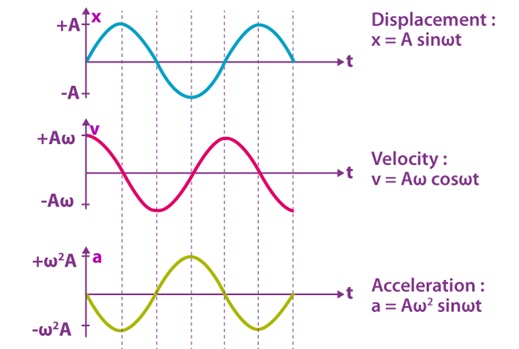
8. Phase Relationship Between Displacement and Velocity
For displacement:
For velocity:
Sine and cosine differ in phase by:
Therefore, displacement and velocity are π/2 radians out of phase.
This corresponds to one quarter of a complete oscillation.
Physical Meaning
At maximum displacement:
At equilibrium:
This is why displacement and velocity cannot reach their maximum values at the same time.
9. Acceleration and Phase
The defining equation of SHM is:
Substituting the displacement equation gives:
Acceleration is therefore exactly opposite in phase to displacement.
The phase difference between displacement and acceleration is:
This corresponds to half of a complete oscillation.
Summary of Phase Relationships
- displacement and velocity differ by π/2 rad;
- velocity and acceleration differ by π/2 rad;
- displacement and acceleration differ by π rad.
10. Velocity as a Function of Displacement
Sometimes the displacement of an oscillator is known but the time is not.
In this situation, the following equation is very useful:
where
v = velocity (m s−1)
ω = angular frequency (rad s−1)
x0 = amplitude (m)
x = instantaneous displacement (m)
11. Derivation of the Velocity–Displacement Relationship
Start with:
Therefore:
The velocity is:
Using the identity:
we obtain:
Therefore:
=
1 − x2/x02
Squaring the velocity equation:
=
ω2x02
cos2(ωt + φ)
Substitute the previous expression:
=
ω2x02
(1 − x2/x02)
Simplifying:
=
ω2(x02 − x2)
Therefore:
12. Why Is There a ± Sign?
At a particular displacement, an oscillator may pass through the same position twice
during one complete cycle.
It may be:
- moving away from equilibrium; or
- moving toward equilibrium.
The two situations have equal speed but opposite velocity.
Therefore:
represents motion in the positive direction, while:
represents motion in the negative direction.
13. Worked Example — Speed at a Given Displacement
An oscillator has:
x0 = 0.10 m
ω = 5.0 rad s−1
Find its speed when:
Use:
Substitute:
Therefore, the speed is:
The velocity may be +0.40 m s−1 or −0.40 m s−1,
depending on the direction of motion.
14. Important Checks on the Velocity Equation
At equilibrium:
Therefore:
and hence:
At maximum displacement:
so:
and therefore:
These results agree with the physical behaviour of simple harmonic motion.
15. Energy in Simple Harmonic Motion
In ideal simple harmonic motion, the total mechanical energy remains constant.
Energy continuously transfers between:
- kinetic energy;
- potential energy.
For a mass–spring system, the potential energy is elastic potential energy.
At the extreme positions, all the mechanical energy is potential energy.
At equilibrium, all the mechanical energy is kinetic energy.
16. Total Energy
The total mechanical energy of an oscillator is:
where
ET = total mechanical energy (J)
m = mass of the oscillating particle (kg)
ω = angular frequency (rad s−1)
x0 = amplitude (m)
For an ideal undamped oscillator, ET remains constant.
17. Derivation of the Total Energy Equation
At equilibrium, the speed is maximum:
All the mechanical energy is kinetic at equilibrium.
Substituting:
Therefore:
Total energy is proportional to the square of the amplitude:
If the amplitude doubles, the total energy becomes four times larger.
If the amplitude triples, the total energy becomes nine times larger.
18. Worked Example — Total Energy
A particle has:
m = 0.20 kg
ω = 8.0 rad s−1
x0 = 0.050 m
Calculate its total energy.
Answer: ET = 1.6 × 10⁻² J
19. Potential Energy
The potential energy of an oscillator at displacement x is:
where
EP = potential energy (J)
m = mass (kg)
ω = angular frequency (rad s−1)
x = displacement from equilibrium (m)
At equilibrium:
so:
At maximum displacement:
and therefore:
which is equal to the total energy.
20. Derivation of the Potential Energy Equation
For a spring:
For a mass–spring oscillator:
Therefore:
Substituting:
Hence:
21. Kinetic Energy
Kinetic energy can be obtained from conservation of mechanical energy:
Therefore:
=
½mω2x02
−
½mω2x2
Factorising:
=
½mω2(x02 − x2)
where
EK = kinetic energy (J)
22. Worked Example — Energy at a Particular Displacement
A mass has:
m = 0.50 kg
ω = 4.0 rad s−1
x0 = 0.10 m
Calculate the total energy, potential energy and kinetic energy when:
Step 1: Total Energy
Step 2: Potential Energy
Step 3: Kinetic Energy
Answers:
ET = 0.040 J
EP = 0.0144 J
EK = 0.0256 J
23. Energy at Important Positions
At Maximum Positive Displacement
At Equilibrium
At Maximum Negative Displacement
24. Energy at Half the Amplitude
A common misconception is that when:
the kinetic and potential energies are equal.
This is incorrect because potential energy depends on the
square of displacement.
At:
the potential energy is:
Therefore:
25. Worked Example — When Are Kinetic and Potential Energy Equal?
Suppose:
Since:
each must be half of the total energy:
Using:
and:
we obtain:
Therefore:
Hence:
or approximately:
26. Energy Changes During One Complete Cycle
Suppose an oscillator starts at maximum positive displacement.
At x = +x0
- velocity is zero;
- kinetic energy is zero;
- potential energy is maximum.
As the oscillator moves toward equilibrium:
- potential energy decreases;
- kinetic energy increases;
- total mechanical energy remains constant.
At x = 0
- speed is maximum;
- kinetic energy is maximum;
- potential energy is minimum.
As the oscillator continues toward −x0, kinetic energy decreases while
potential energy increases.
At x = −x0
- velocity is zero;
- kinetic energy is zero;
- potential energy is maximum.
The process then repeats.
27. Energy as a Function of Time
If:
then:
=
½mω2x02
sin2(ωt + φ)
The total energy is:
=
½mω2x02
Therefore, the kinetic energy is:
=
½mω2x02
cos2(ωt + φ)
Because sin2 and cos2 repeat twice during one oscillation,
the energy changes have twice the frequency of the displacement.
and therefore:
28. Diagram Guidance — Energy Graphs
For a graph of energy against displacement:
- potential energy is a parabola opening upward;
- kinetic energy decreases from a maximum at equilibrium to zero at the extremes;
- total energy is represented by a horizontal line.
At:
kinetic energy is maximum and potential energy is zero.
At:
potential energy equals the total energy and kinetic energy is zero.
The kinetic and potential energy curves intersect at:
29. Common Misconceptions and Mistakes
1. Using degrees in phase calculations
Phase calculations must use radians. Make sure your calculator is in
radian mode.
2. Assuming the ± sign means uncertainty
In v = ±ω√(x02 − x2), the ± sign represents the
two possible directions of motion.
3. Assuming potential energy depends on the sign of x
Potential energy depends on x2. Therefore, it is the same at +x and −x.
4. Assuming energy is equally shared at half-amplitude
At x = x0/2, potential energy is only ¼ of the total energy.
5. Confusing maximum displacement with maximum velocity
At maximum displacement, v = 0. At equilibrium, the speed is maximum.
6. Forgetting that total energy depends on amplitude squared
ET ∝ x02. Doubling the amplitude quadruples
the total energy.
30. IB Exam Tips
Tip 1 — Use Radians
For all phase calculations, ensure that your calculator is in radian mode.
Tip 2 — State the Initial Conditions
When choosing between sine and cosine forms, explain the initial position and direction
of motion.
For example:
“The particle starts at equilibrium moving in the positive direction, so
x = x0 sin(ωt) is appropriate.”
Tip 3 — Distinguish Speed from Velocity
If your calculation gives ±0.40 m s−1 and the question asks for speed,
give 0.40 m s−1. If it asks for velocity, determine the appropriate
sign from the direction of motion.
Tip 4 — Explain Energy Transfers Precisely
A strong IB statement is:
“As the oscillator moves toward equilibrium, potential energy is converted into
kinetic energy while the total mechanical energy remains constant.”
Tip 5 — Use Conservation of Energy
Many HL questions can be solved efficiently using:
31. Short Practice — Phase and Motion
- What phase angle corresponds to one quarter of a complete oscillation?
- What phase angle corresponds to half an oscillation?
- State the phase difference between displacement and velocity.
- State the phase difference between displacement and acceleration.
- Why must radians be used in SHM phase calculations?
32. Calculation Practice
Question 1
A particle performs SHM with:
x0 = 0.060 m
ω = 10 rad s−1
φ = 0
Calculate the displacement at t = 0.10 s.
Question 2
An oscillator has:
x0 = 0.080 m
ω = 6.0 rad s−1
Calculate its maximum speed.
Question 3
An oscillator has:
x0 = 0.12 m
ω = 5.0 rad s−1
Calculate its speed when x = 0.072 m.
33. HL Energy Practice
Question 4
A 0.25 kg oscillator has:
ω = 8.0 rad s−1
x0 = 0.050 m
(a) Calculate the total energy.
(b) Calculate the potential energy at x = 0.030 m.
(c) Calculate the kinetic energy at this displacement.
Question 5
An oscillator has total energy:
Determine its kinetic and potential energies when:
Question 6
At what displacement, expressed as a fraction of the amplitude, are kinetic and
potential energies equal?
34. HL Application Question
A particle of mass 0.40 kg performs SHM with amplitude 0.080 m and period 0.50 s.
(a) Calculate its angular frequency.
(b) Calculate its maximum speed.
(c) Calculate its total mechanical energy.
(d) Calculate its speed when its displacement is 0.050 m.
(e) Calculate its potential energy at this displacement.
(f) Explain why the particle passes through this displacement twice
during each complete oscillation but may have two different values of velocity.
35. Key Equations
Phase and Displacement
where
x = displacement (m)
x0 = amplitude (m)
ω = angular frequency (rad s−1)
t = time (s)
φ = phase constant (rad)
Velocity
Maximum Speed
Velocity at a Given Displacement
Total Energy
Potential Energy
Kinetic Energy
36. Key Ideas to Remember
The phase angle:
specifies where an oscillator is within its cycle.
The displacement varies sinusoidally:
Velocity is π/2 rad out of phase with displacement:
Acceleration is π rad out of phase with displacement:
The maximum speed occurs at equilibrium:
The velocity at any displacement may be found from:
For an ideal oscillator, total mechanical energy remains constant:
Potential energy is:
Kinetic energy is:
At equilibrium, the mechanical energy is entirely kinetic. At the extreme positions,
the mechanical energy is entirely potential.
Tag:C.1 SHM HL

You may also like

Simple Harmonic Motion 1

IB Physics HL Fast Paper 2 Shortcuts
