

What is statistical hypothesis testing?
Hypothesis testing is a statistical technique used to make inferences about a population parameter based on a sample of data. The process involves formulating a hypothesis about the population parameter, collecting data, and then using statistical techniques to determine whether the evidence from the sample supports or contradicts the initial hypothesis.
Key components of hypothesis testing include
The null hypothesis (H₀): This is a statement of no effect or no difference. It is the standard assumption that there is no change or relationship in the population.
Alternative hypothesis (H₁ ): This is a statement that contradicts the null hypothesis and suggests that there is a significant effect or difference in the population.
Significance level (α): This is the probability of rejecting the null hypothesis if it is true. Common choices for the significance level are 0.05, 0.01, or 0.10.
Test statistic: A statistical measure calculated from the sample data to evaluate the evidence against the null hypothesis.
P-value: The probability of obtaining a test statistic that is as extreme as or more extreme than the one observed, assuming the null hypothesis is true. A smaller p-value indicates stronger evidence against the null hypothesis.
Decision rule: Based on the p-value and the significance level, the null hypothesis is either rejected or not rejected.
Here’s a simple example:
Scenario: A company claims that the average time it takes to process an order is 24 hours.
Hypotheses:
Null hypothesis (H₀): The average order turnaround time is 24 hours.
Alternative hypothesis (H₁): The average order processing time is not 24 hours.
Data collection:
A sample of 30 orders is collected and the average processing time is calculated to be 22.5 hours with a standard deviation of 3 hours.
Analysis:
A t-test is performed and the p-value is calculated.
Decision rule:
If the p-value is less than the selected significance level (e.g. 0.05), the null hypothesis is rejected.
Conclusion:
If the p-value is less than 0.05, there is sufficient evidence to reject the null hypothesis, indicating that the average turnaround time is significantly different from the claimed 24 hours.
Hypothesis testing is widely used in various fields to draw conclusions from data and make informed decisions based on statistical evidence.

You may also like
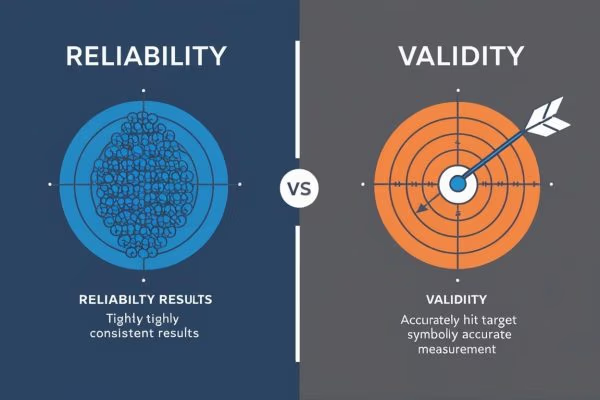
Data Collection, Categorization, Reliability and Validity

Hypothesis Tests explained
